 Untilfree
Retirement Countdown: How Many Days Until You’re Free?
A retirement countdown turns a far-off goal into a number that shrinks every night. The question is what you count down to: a birthday, or the day your money could take over.
Two kinds of countdown
The calendar countdown counts to a fixed date: your planned retirement age or a date your employer gave you. It is simple and certain. Someone born in 1980 who plans to stop at 67 has roughly 7,500 days to go from late 2026. You can count weekdays only, if you want to see the working days left.
The money countdown counts to the day your savings could pay your bills. That date is not fixed. It moves when you invest more, when you spend less, and when markets do well or badly. It answers a different question: not "when am I allowed to stop?" but "when could I afford to?"
Why counting days helps
Years feel abstract. "Twenty-six years" sounds the same this month as next month. Days change. Watching 9,561 become 9,560 overnight makes progress visible, and a visible goal is easier to keep. People use countdowns for the same reason they use streaks: a small daily signal keeps a long plan alive.
A money countdown adds something a calendar cannot: feedback. Skip a purchase, add to savings, and the day comes closer. Spend more every month, and it moves away. Your choices show up as days.
A worked example
Maya is 34. She has $60,000 invested, adds $1,200 a month and spends $3,200 a month. Assuming 5% growth a year after inflation and the common 4% rule, her savings could cover her spending in about 26 years — roughly 9,560 days, around age 60.
That is seven years before her planned retirement age. Her calendar countdown and her money countdown tell two different stories, and the second one is the one she can change.
What moves a money countdown
- Spending. A lower monthly cost lowers the amount you need and raises what you can invest. It works twice.
- Monthly investing. A raise you invest instead of spend can pull the date in by years.
- One-off amounts. A bonus added to savings moves the date sooner; a big purchase pushes it back.
- Markets. Returns are never smooth, so a good estimate shows a range, not one date.
Do weekends and holidays count?
For a calendar countdown, count calendar days if you want the plain answer, or weekdays if you care about the working days left. Public holidays and leave vary by country and employer, so most countdowns leave them in. For a money countdown, every day counts: your investments keep growing on weekends too.
Questions people ask
What is a retirement countdown clock?
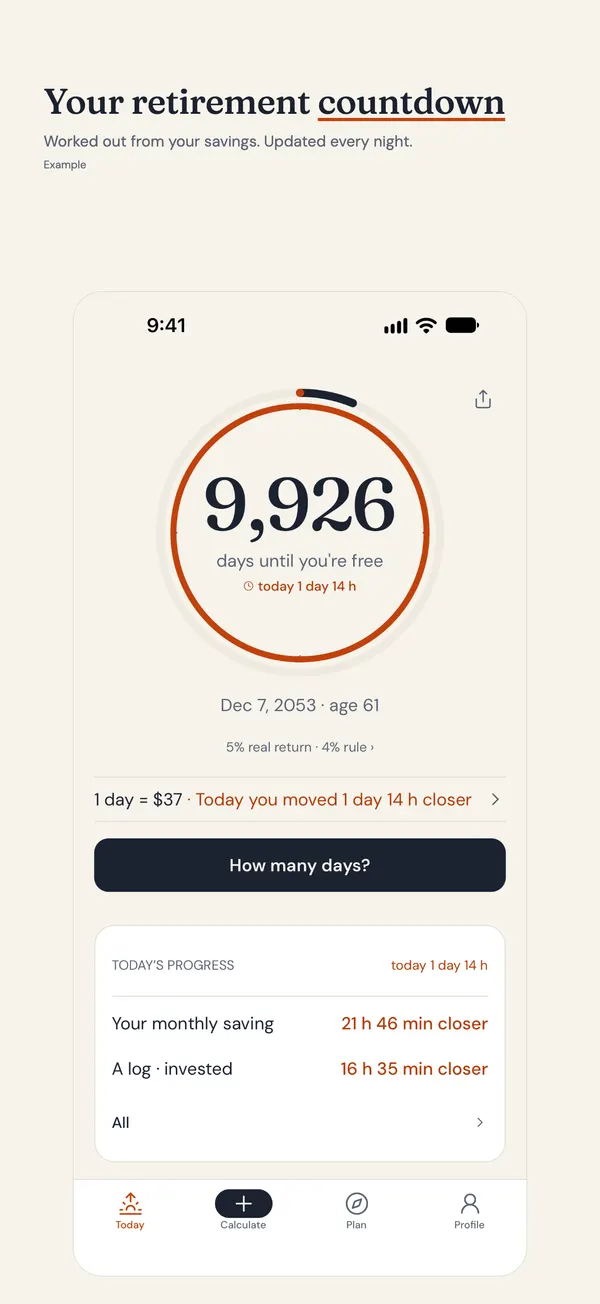
It is a counter that shows the days (sometimes hours) left until your retirement date. Some sit on a desk or a phone home screen. Untilfree’s version counts down to the day your savings could pay your bills, and it updates every night.
How do I work out the days until my retirement?
For a fixed date, count the calendar days from today to that date. For a money-based date, you need your savings, monthly investing and spending; Untilfree does that part for you and keeps it up to date.
Do weekends count in a retirement countdown?
In a calendar countdown, that is up to you: calendar days give the simple answer, weekdays show working days left. In a money countdown every day counts, because your savings grow every day.
Is there a retirement countdown app?
Yes. Untilfree is a countdown app for iPhone that counts to your financial freedom day, works it out from four numbers and keeps your data on your phone. It is free to download, with ads and an optional Plus upgrade.
Why does my countdown change?
Because the inputs change: what you saved, what you spent, how markets did. That is the point — it shows you what your choices are worth in days.
Your countdown, on your phone, in under a minute
Four questions — your age, savings, monthly investing and monthly spending — and Untilfree gives you a date. Then it counts down every midnight. Skip a purchase or add to savings and watch the day come closer.
- A daily countdown ring with your date and age
- Cautious, likely and optimistic dates side by side
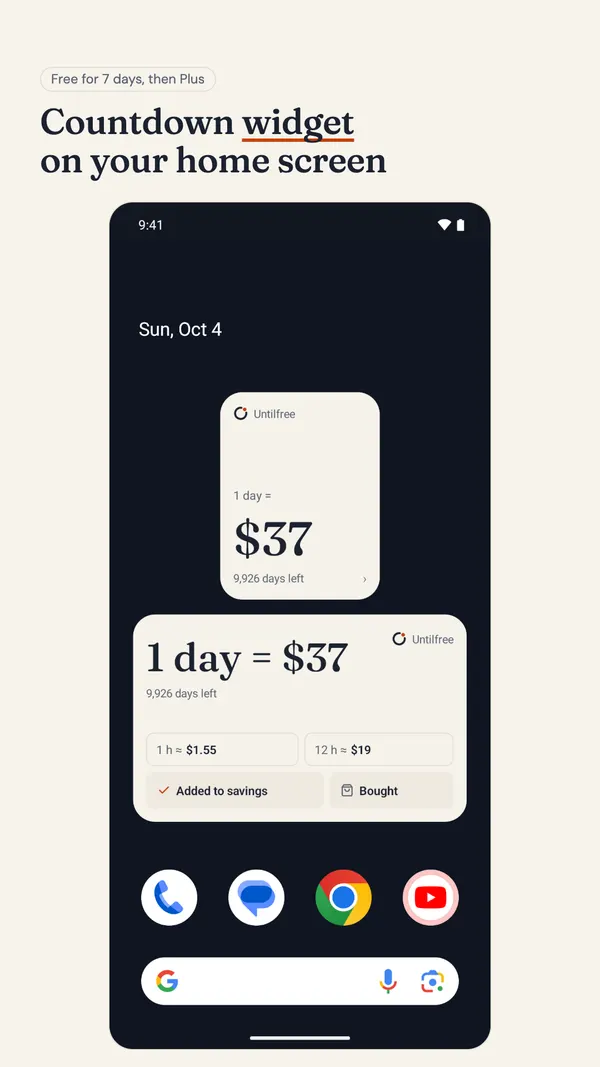
- Home screen widget (Plus after a 7-day trial)
App Store · Free · Ads, optional Plus · No account · No bank link
Untilfree gives estimates in today’s money (after inflation). Taxes and state pensions are not included. This page is general information, not investment advice.
Published · by Srofia