 Untilfree
The Latte Factor: Do Small Habits Really Delay Your Freedom?
The latte factor is the idea that small daily spending, like a coffee on the way to work, adds up to a surprising amount over decades. It is partly true, partly overstated, and useful if you treat it the right way.
What the latte factor says
A small amount spent every day looks harmless. But daily means about 365 times a year, and money invested instead keeps growing. Over 30 years, a habit that costs a few dollars a day can grow into a sum large enough to notice.
Five dollars a day is about $150 a month. Over 30 years that is roughly $55,000 paid. Invested instead at 5% a year after inflation, it could grow to around $121,000 in today's money.
For someone who is 32, has $40,000 invested, adds $1,500 a month and spends $3,000, keeping that daily habit pushes their freedom day back by roughly nine months.
Is the latte factor a myth?
Not a myth, but often used badly. Fair criticisms:
- Big costs matter more. Rent, cars and food at home dwarf coffee. Cutting one big cost beats skipping every small pleasure.
- Joy has value. If the coffee is the best part of your morning, it may be worth every cent.
- Guilt does not last. Plans built on denial tend to fail.
The useful version is not "never buy coffee". It is: know what your habits cost, keep the ones you love, and drop the ones you do not even notice.
Find your own "lattes"
Most people's real latte factor is not coffee. It is the subscriptions they forgot, delivery fees, the snack at the station, the in-app purchase. Look at a month of statements and mark anything that repeats. Ask of each: would I buy this again today, on purpose?
Turn skipping into a win
Cutting back feels like loss. It works better as a win you can see. When you skip something, note it and move the money to savings the same day. Watching those small amounts add up — as minutes and hours of freedom — makes the next "no, thanks" easier.
Where the idea helps most
The latte factor is most useful early on, when your pot is small and every amount invested has decades to grow. It also helps as a mindset: if you can see what small things cost, bigger choices — a car, a move, a new subscription tier — get the same careful look. Later in the road, when your investments are large, a daily coffee barely moves the date, and that is a good sign you can enjoy it.
Monthly beats daily
A one-off coffee is a few minutes. A habit is a monthly cost, and a monthly cost moves your freedom day for good. That is where small things really show up.
Questions people ask
What is the latte factor?
The idea that small, regular spending adds up to a large sum over time, especially if the money is invested instead. Coffee is just the classic example.
Is the latte factor a myth?
No, the maths is real, but it is often overstated next to big costs like housing and transport. Use it to spot habits you do not value, not to give up the ones you do.
How much does a daily coffee cost over 30 years?
At $5 a day, about $55,000 paid. Invested at 5% a year after inflation, it could grow to around $121,000 in today’s money.
Do small habits compound?
Yes. Money invested earns growth, and that growth earns growth. That is why a regular habit matters more than a single purchase.
Count your skipped coffees as time won
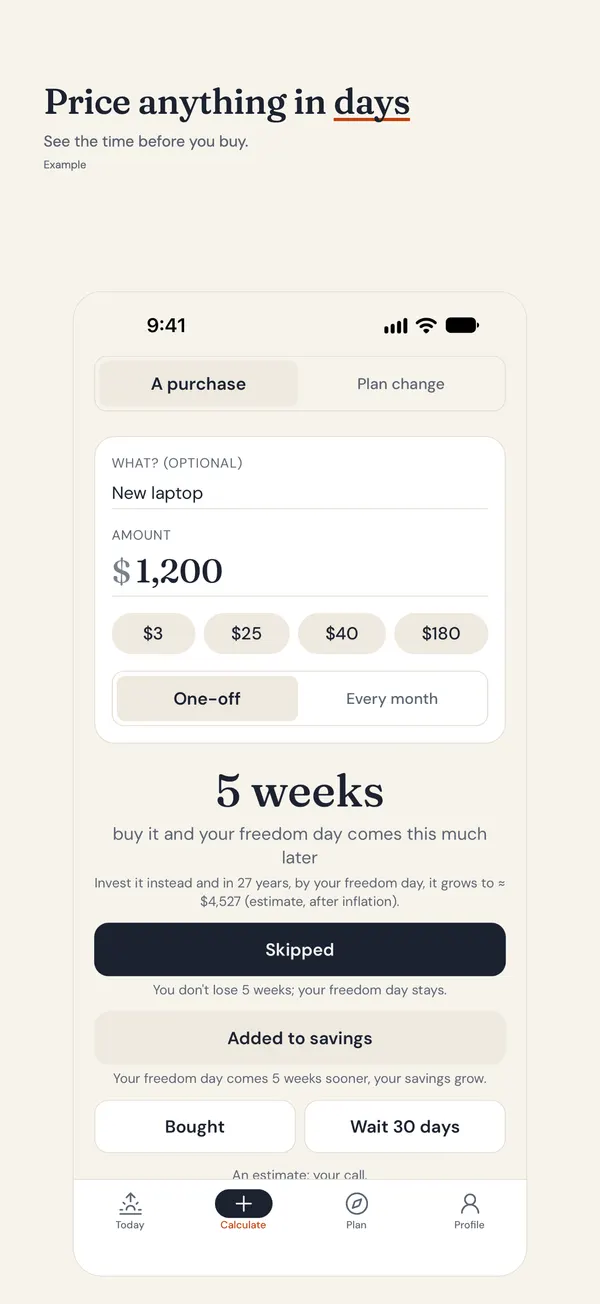
Four questions — your age, savings, monthly investing and monthly spending — and Untilfree gives you a date. Then log what you skip: tap "Added to savings" and your freedom day comes minutes closer.
- Price any habit in days, one-off or monthly
- Share the time you kept — never the money
- Your numbers stay on your phone
App Store · Free · Ads, optional Plus · No account · No bank link

Untilfree gives estimates in today’s money (after inflation). Taxes and state pensions are not included. This page is general information, not investment advice.
Published · by Srofia